Here’s Why Mortgage Rates Are Where They Are Right Now for St. Louis Buyers
Here’s Why Mortgage Rates Are Where They Are Right Now (And Why St. Louis Buyers Shouldn’t Wait for an 8% Drop)
If you’re a St. Louis buyer hoping mortgage rates will fall a lot before you jump in, you may be waiting longer than you’d like. But there’s a number working behind the scenes right now that’s actually working in your favor, and once you understand it, today’s rates start to look a lot different.
It’s called the spread, and it explains almost everything about why rates are sitting where they are.
Rates Follow the 10-Year Treasury, Not Their Own Path
Mortgage rates don’t move in isolation. They tend to track the 10-year Treasury yield, a number that reflects how investors feel about the economy overall.
It’s not a perfect one-to-one relationship, since plenty of other factors nudge things day to day, but broadly speaking, the yield climbs when the economy looks strong and eases when the outlook gets shaky. For more than 50 years, the 10-year Treasury yield and mortgage rates have moved together almost in lockstep.
The Gap That Determines Your Rate
The difference between the two is called the spread, and historically it averages about 1.76 percentage points. That spread matters a lot: when it widens, mortgage rates climb higher than the Treasury yield alone would suggest. When it narrows, rates settle closer to the yield itself.
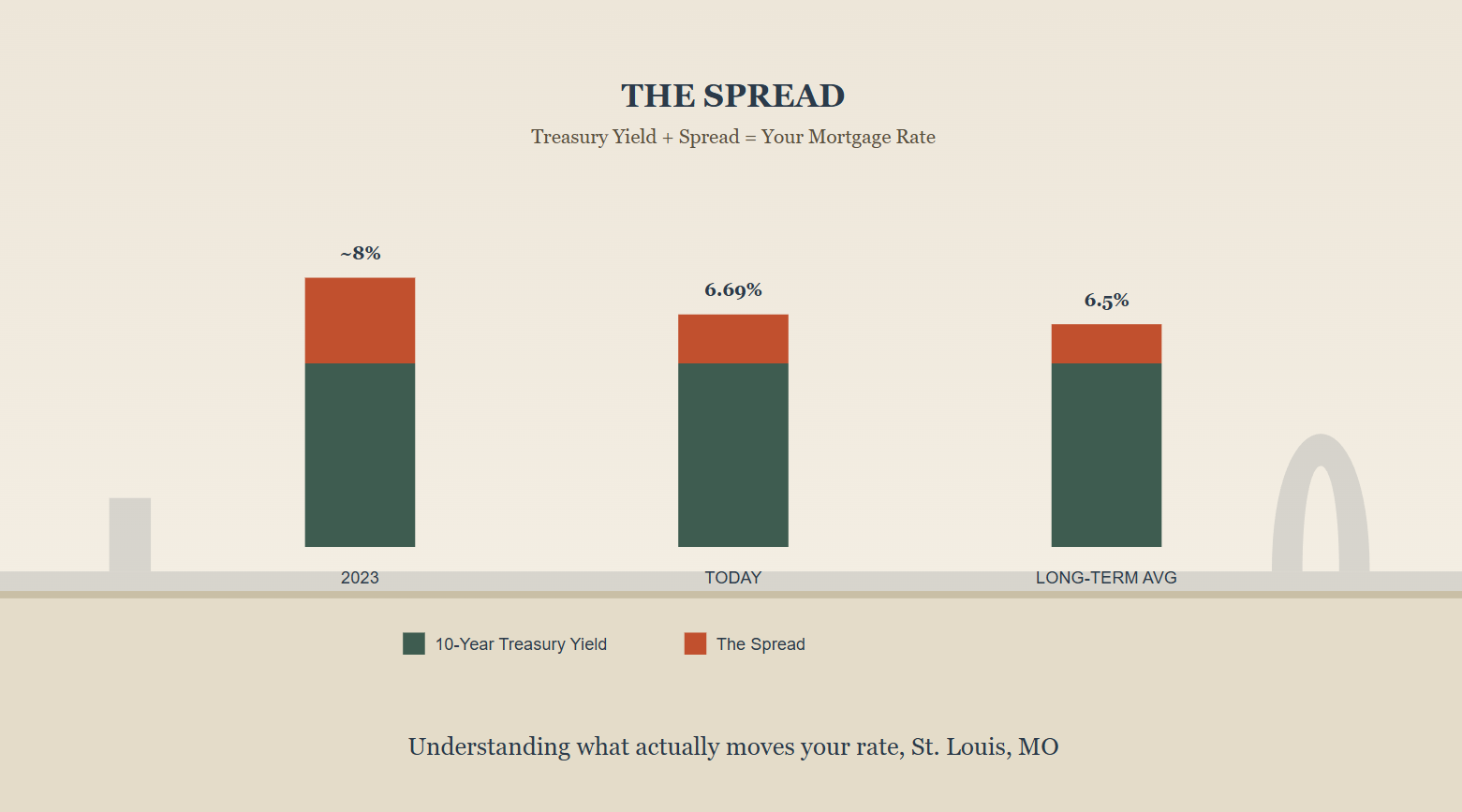
A few years back, uncertainty in the broader economy pushed that gap unusually wide, up to 3.19 points in 2023. Since then, it’s been shrinking. Today it sits around 2.01, just a bit above the long-term average of 1.76.
Why Rates Probably Won’t Drop Much Further
Here’s the part worth sitting with: when the spread is wide, there’s a lot of room for rates to come down as it normalizes. When the spread is close to its historical average, like now, that room shrinks fast.
Your mortgage rate is essentially the Treasury yield plus the spread. With today’s 10-year Treasury yield around 4.68%, here’s what that spread has meant in practice: at the wide 2023-level spread of 3.19, a rate today would be pushing close to 8%. At today’s actual spread of 2.01, rates land around 6.69%. And if the spread fell all the way to its long-term average of 1.76, rates would only drop to around 6.5%, roughly a quarter point below where they already sit.
Industry analysts have pointed to this narrowing spread as one of the more encouraging housing stories of the year, since it’s a meaningful part of why rates aren’t sitting closer to 8% right now. But that same math cuts both ways: with the spread already close to normal, most of the improvement it can offer has already shown up in today’s rate, which means a dramatic further drop probably isn’t coming from this factor alone.
What This Means for St. Louis Buyers
Waiting for rates to fall sharply could mean waiting on a shift that, based on how the spread has already normalized, may simply not be coming anytime soon. Rates today are meaningfully better than they could have been if the spread had stayed as wide as it was in 2023, even if they’re not as low as many buyers are hoping for.
Bottom Line
That’s the trade-off that comes with a narrowing spread. Rates in St. Louis may not be exactly where you’d like them, but they’re already reflecting most of the relief that spread has to offer. If you want to understand what today’s rate actually means for your monthly payment, a local lender can walk you through the real numbers for your situation.
Your Local St. Louis Mortgage Team
Since 2004, Carlson Mortgage loan officers have helped over a thousand St. Louis home buyers find the right loan, including conventional, FHA, VA, and jumbo financing up to $3.5 million. We’re rated the #1 mortgage company on Yelp and top-rated on Zillow, Facebook, and Google.
Call or text: 314-329-7314 Apply securely: www.carlsonstl.com/apply Email: info@carlsonstl.com
Share Your Thoughts!